
You attend a major medical congress. Over three days you sit through dozens of sessions, photograph slide after slide, snap a few posters on the way to lunch and leave with a camera roll full of images.
A month later, you need one specific slide: a data table from a keynote, or a poster about a subgroup analysis. You scroll through hundreds of photos, many blurry, none labelled, with no idea which session they came from.
This is one of the most common frustrations in medical and scientific work, and it is entirely avoidable.
Why congress knowledge gets lost
Congresses are among the most valuable and expensive learning opportunities in medicine. Registration, travel, accommodation and time away from work add up quickly. Yet the way most people capture information has not changed in years:
- Camera rolls are chaotic. Congress photos get mixed with personal pictures, screenshots and everything else.
- Nothing is organised. Photos have no session titles, speakers or topics attached.
- Notes are incomplete. Taking notes while trying to follow a presentation means missing content.
- Memory fades fast. Within days, the specific details that made a session valuable start to disappear.
The insight that justified the trip becomes difficult to find, so it never gets used.
Information that isn't findable isn't useful
There is a simple rule here: knowledge you cannot retrieve is knowledge you do not have. The value of a congress is not only in attending sessions, but in being able to return to what you learned when decisions need to be made, when a colleague asks a question or when you are preparing your next project.
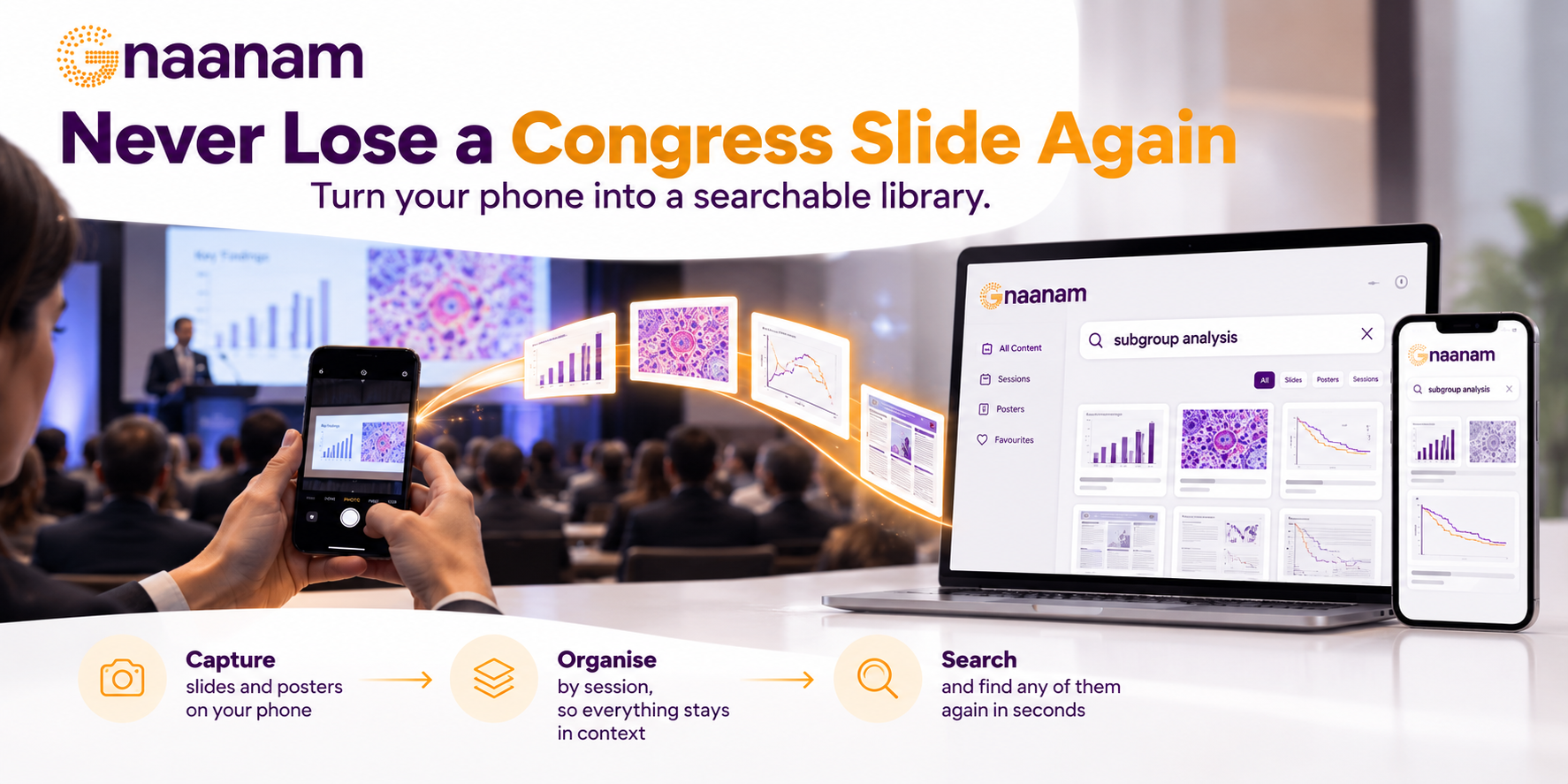
How Gnaanam works
Gnaanam, an Orakris tool, is built to solve exactly this problem. It turns what you see at a congress into a searchable library. You can:
- Capture slides and posters directly from your phone
- Organise them by session, so everything stays in context
- Search and find any of them again in seconds
Instead of a mixed-up camera roll, you have a structured library tied to the sessions you attended.
Who benefits from congress capture
- Medical science liaisons (MSLs) need to retain and share insights from scientific exchange at conferences, and to brief internal teams afterwards.
- Researchers can keep track of relevant data, methods and emerging findings, and revisit them while planning studies or writing papers.
- Clinicians can hold on to practice-relevant updates and bring them back to their teams.
- Field and commercial teams can keep accurate records of scientific content they need to understand, subject to their organisation's compliance policies.
Tips for getting more from your next congress
Regardless of the tools you use, these habits help:
- Plan your sessions in advance. Know which talks matter most so you can focus your capture on them.
- Capture selectively. Photograph the slides that carry key data or conclusions instead of every slide.
- Organise the same day. Details are easiest to attach while the session is fresh.
- Review within a week. Revisit your captures while the context is still clear, and note actions or follow-ups.
- Share insights, not only images. Summarise key takeaways for colleagues who were not there.
- Check congress rules. Some sessions restrict photography, so always follow the policies of the event and presenters.
The bigger idea: conversations and sessions fade, so capture them
Great learning, whether in a lecture hall or a ten-minute chat with an expert, is easy to lose. The sharpest details disappear within a day or two, and what remains is a vague feeling that you learned something important. Tools that help you capture and retrieve that knowledge make the original investment in attending far more valuable.
Conclusion
Congresses are expensive, and what you learn there should last longer than the trip. Gnaanam gives you a simple way to capture, organise and find what you saw, so the insight you gained stays useful long after you've left the venue.
Retain What You Learn at Congresses
To learn how Gnaanam can support your team at the next congress and transform individual learning into shared institutional knowledge, get in touch with Orakris.